India’s textile industry is known around the world for extraordinary diversity.
From refined silk fabrics and intricate jacquards to elaborate brocades and contemporary woven textiles, Indian fabrics continue to influence wedding wear, ethnic fashion, designer collections and luxury garments.
Within this enormous textile landscape, Banarasi fabrics from Varanasi hold a distinctive position.
Their identity comes from a rich design vocabulary, woven texture, sophisticated patterns and a textile tradition closely connected with Banaras.
Today, Banarasi textiles are no longer limited to conventional applications.
They are increasingly being explored for modern men’s kurtas, groom sherwanis, Indo-Western outfits, Nehru jackets, bandhgalas, wedding jackets and designer menswear.
For buyers searching online for a trusted Banarasi fabric supplier in India, choosing the right sourcing partner is about much more than finding attractive fabrics.
Professional buyers need to consider:
- Fabric category
- Design relevance
- Weave
- Texture
- Width
- Weight
- Pattern repeat
- Motif scale
- Colour
- Garment suitability
- Quantity
- Sourcing requirements
At Choubey Silk, Varanasi, our focus is on premium fabrics for men’s ethnic, wedding and occasion wear.
Our collections include Banarasi jacquard, brocade, Katan silk, Moonga, Chiniya, raw silk, satin-based fabrics and other premium woven textiles suitable for a range of garment applications.
We cater to different sourcing requirements, including individual customers, fashion designers, boutiques, retailers, wholesalers, garment manufacturers and international textile buyers.
Whether you are searching for Banarasi fabric in Varanasi, wholesale men’s fabrics, premium jacquard for a designer collection, brocade for groom wear or textiles for garment manufacturing, the sourcing process should begin with understanding the intended use of the fabric.
This comprehensive guide explores what buyers should look for in a Banarasi fabric supplier and how Choubey Silk approaches the evolving requirements of modern men’s fashion.
Banarasi Fabrics: A Textile Identity Rooted in Varanasi
Varanasi—also widely known as Banaras or Kashi—has a long and celebrated association with textile weaving.
Over generations, the city’s textile environment has developed a rich visual vocabulary.
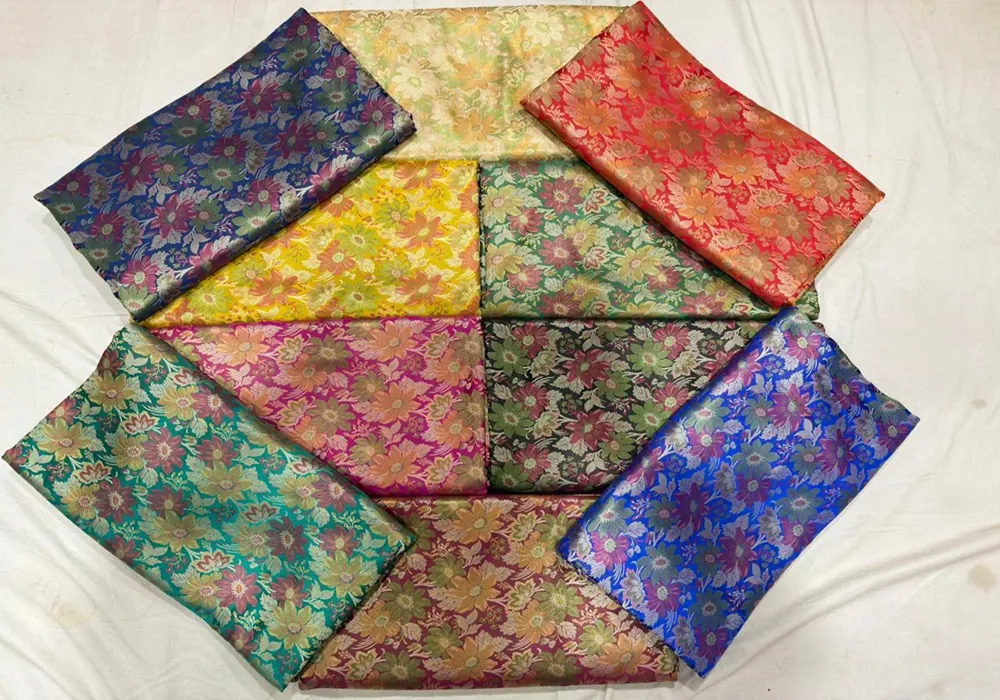
Banarasi textile designs can include:
- Floral motifs
- Butis
- Jaals
- Paisleys
- Botanical forms
- Mughal-inspired patterns
- Shikargah-inspired designs
- Geometric arrangements
- Zari detailing
- Contemporary patterns
This design diversity is one of the reasons Banarasi fabrics remain relevant.
Heritage does not need to mean repetition.
Traditional textile ideas can be adapted through new colours, different motif scales, modern geometry and contemporary garment silhouettes.
Banarasi Fabrics for Modern Men’s Fashion
Men’s Indian fashion has changed significantly.
Traditional garments remain important, but customers now have a much broader range of choices.
Modern men’s wardrobes can include:
- Designer kurtas
- Groom sherwanis
- Indo-Western outfits
- Nehru jackets
- Bandhgalas
- Wedding jackets
- Contemporary ethnic wear
Each garment requires a different textile approach.
A lightweight-looking self-jacquard may work beautifully for a kurta.
A richer brocade can create a ceremonial sherwani.
A geometric jacquard can become an Indo-Western jacket.
A dark tonal textile can create a sophisticated bandhgala.
This is why a premium fabric supplier needs to understand more than the textile name.
The intended garment matters.
What Should Buyers Look for in a Banarasi Fabric Supplier?
A buyer searching for a Banarasi fabric supplier in India should evaluate several factors.
Fabric Variety
Different garments require different textiles.
A useful sourcing range may include jacquards, brocades, silk-based fabrics and contemporary woven designs.
Design Variety
The collection should ideally offer options for both traditional and contemporary markets.
Garment Relevance
A textile may be beautiful but unsuitable for the intended garment.
Technical Information
Width, repeat, weight and motif direction matter for professional production.
Understanding of Buyer Requirements
A designer, retailer and garment manufacturer have different sourcing needs.
The more clearly these requirements are understood, the more efficient the selection process becomes.
Choubey Silk and Premium Banarasi Fabrics
At Choubey Silk, our men’s fabric direction focuses on combining the textile character associated with Varanasi with the requirements of contemporary ethnic and wedding fashion.
Our broader collections can include:
- Banarasi jacquard
- Banarasi brocade
- Katan silk
- Moonga
- Chiniya
- Raw silk
- Satin-based fabrics
- Premium woven textiles
These can be explored according to garment type, design direction, colour and sourcing requirement.
Banarasi Jacquard Fabric Supplier in Varanasi
Banarasi jacquard is one of the most versatile categories for men’s fashion.
The woven design can range from extremely subtle to visually rich.
Jacquard directions can include:
- Self-patterns
- Florals
- Small butis
- Geometry
- Checks
- Stripes
- Heritage-inspired motifs
- Zari designs
This versatility makes jacquard useful for designers and retailers serving multiple customer profiles.
Banarasi Jacquard for Men’s Kurtas
For designer kurtas, jacquard can provide woven texture without requiring excessive additional decoration.
Self-jacquard can create understated luxury.
Small floral motifs can provide festive character.
Geometry can make the garment more contemporary.
Subtle zari can add wedding richness.
This allows one broad textile category to serve many kurta styles.
Banarasi Jacquard for Sherwanis
Sherwanis generally provide a larger surface for woven design.
This allows jacquard patterns to become more visible.
Floral jacquards can create heritage styling.
Geometric patterns can provide a modern groom aesthetic.
Self-jacquards can create minimal luxury.
Richer metallic patterns can work for ceremonial wedding wear.
Banarasi Jacquard for Indo-Western Fashion
Indo-Western menswear is an important area for contemporary Banarasi fabrics.
Geometric patterns are particularly effective for:
- Long jackets
- Asymmetric outfits
- Bandhgalas
- Nehru jackets
- Contemporary groom wear
The woven textile maintains an Indian character while modern tailoring changes the overall visual identity.
Banarasi Brocade Fabric Supplier in Varanasi
For buyers seeking richer ceremonial fabrics, Banarasi brocade is an important category.
Brocade can feature:
- Floral jaals
- Paisleys
- Botanical vines
- Mughal-inspired designs
- Traditional butis
- Contemporary patterns
Depending on its construction and design, brocade can be explored for sherwanis, wedding jackets, Nehru jackets and statement Indo-Western garments.
Banarasi Brocade for Groom Wear
The groom’s main wedding garment often requires greater visual presence than ordinary occasion wear.
Brocade can provide that presence through its woven surface.
Ivory-and-gold designs can create a traditional aesthetic.
Champagne brocade can appear more contemporary.
Pastels can suit daytime weddings.
Darker brocades can create strong evening garments.
The best choice depends on the groom and garment.
Katan Silk Fabric for Premium Men’s Wear
Katan silk is another important direction in premium Banarasi fashion.
Depending on its specific construction and design, Katan-based fabric can be considered for:
- Premium kurtas
- Sherwanis
- Indo-Western garments
- Wedding jackets
- Groom wear
The textile should be evaluated according to actual garment requirements rather than selected only because of its category name.
Moonga Fabrics for Men’s Fashion
Moonga can provide another visual and textural direction for premium men’s garments.
It can be explored according to the required garment structure, colour and occasion.
For designers, having multiple textile categories available creates greater flexibility when developing complete collections.
Chiniya Fabrics for Contemporary Menswear
Chiniya fabrics can provide another option for premium ethnic-wear applications.
As with every textile, suitability should be evaluated according to:
- Weight
- Drape
- Texture
- Design
- Garment silhouette
This ensures that fabric selection is based on the final garment rather than only appearance.
Raw Silk for Men’s Ethnic Wear
Raw silk can provide a distinctive natural-looking texture.
This can be particularly useful when a designer wants visible surface character without elaborate woven motifs.
It can work effectively in contemporary men’s fashion, especially where texture itself is intended to become part of the design language.
Satin-Based Fabrics for Men’s Occasion Wear
Satin-based constructions can offer a smoother surface and different light reflection.
Depending on the particular textile, they can be explored for occasion wear and garments requiring a refined surface.
Again, the final choice should consider structure, drape and intended application.
Banarasi Fabric for Men’s Kurtas
Men’s kurtas represent one of the broadest categories for premium fabrics.
The garment can range from simple festive wear to sophisticated wedding clothing.
Fabric directions can include:
- Self-jacquard
- Floral jacquard
- Geometric jacquard
- Small butis
- Katan-based textiles
- Subtle zari
- Checks
- Stripes
This gives designers and buyers enormous creative flexibility.
Banarasi Fabric for Sherwanis
The sherwani requires greater consideration of structure and motif placement.
Potential textile directions include:
- Banarasi brocade
- Floral jacquard
- Geometric jacquard
- Katan-based fabrics
- Zari patterns
- Self-jacquard
The ideal textile depends on whether the garment is traditional, contemporary, minimalist or statement-driven.
Banarasi Fabrics for Indo-Western Outfits
Indo-Western fashion creates an opportunity to reinterpret Banarasi textiles.
A traditional floral pattern can become a modern jacket.
Geometry can create a contemporary bandhgala.
Brocade can be used as a statement layer over a simple kurta.
Self-jacquard can create a minimalist groom outfit.
This versatility makes Banarasi fabrics highly relevant to modern men’s fashion.
Banarasi Fabrics for Nehru Jackets
The Nehru jacket is particularly suitable for woven textiles because its relatively compact surface can accommodate strong patterns.
Possible choices include:
- Brocade
- Geometry
- Floral jacquard
- Checks
- Stripes
- Small butis
- Zari designs
A statement jacket can transform an otherwise simple kurta outfit.
Banarasi Fabrics for Bandhgalas
Bandhgalas combine Indian identity with formal tailoring.
This makes them well suited to:
- Self-jacquard
- Tonal patterns
- Geometry
- Dark jacquards
- Restrained metallic designs
Navy, wine and other deeper colours can be particularly effective for evening occasions.
Banarasi Fabrics for Groom Wear
The modern groom may require multiple outfits across several wedding events.
This creates different textile opportunities.
Engagement
Champagne, ivory, beige and pastel jacquards.
Mehendi
Fresh colours, small motifs and lighter visual patterns.
Sangeet
Metallic geometry and stronger woven designs.
Wedding Ceremony
Brocade, premium jacquard and silk-based textiles.
Reception
Dark jacquards, bandhgalas and contemporary jackets.
One wedding wardrobe can therefore incorporate several different Banarasi textile directions.
Modern Colours in Banarasi Men’s Fabrics
Colour has become increasingly important in men’s wedding and ethnic fashion.
Traditional shades continue to have relevance, but the modern palette is broader.
Important directions include:
- Ivory
- Cream
- Champagne
- Beige
- Baby pink
- Pista
- Sage
- Powder blue
- Lavender
- Peach
- Navy
- Wine
- Maroon
Woven texture can give these colours additional depth.
Ivory and Gold Banarasi Fabrics
Ivory and gold remain a classic combination.
But even within this palette, the final aesthetic can vary significantly.
Bright gold can create stronger ceremonial impact.
Antique gold can appear more restrained.
Self-patterning can create minimalism.
Geometry can modernise the textile.
Small meena accents can introduce colour.
This is why design selection matters as much as colour.
Pastel Banarasi Fabrics
Pastels have become particularly relevant to daytime and destination wedding fashion.
Baby pink, pista, powder blue, lavender and peach can create softer men’s garments.
When combined with woven pattern, these shades gain visual depth.
Pastels can be particularly effective for kurtas, jackets and contemporary groom outfits.
Dark Banarasi Fabrics
Evening events create opportunities for deeper colours.
Navy, wine, maroon and dark jewel tones can work beautifully with jacquard.
Metallic designs become more visible against darker bases.
Tonal patterns can create sophisticated formal wear.
These fabrics can be particularly effective for bandhgalas and reception jackets.
Geometric Banarasi Fabrics
Geometry is one of the most important contemporary directions in men’s woven fabrics.
Possible designs include:
- Diamonds
- Grids
- Interlocking shapes
- Linear patterns
- Architectural motifs
- Abstract arrangements
These designs can appeal to customers who want Indian woven textiles without conventional floral styling.
Floral Banarasi Fabrics
Floral designs remain important because they connect naturally with Banarasi textile vocabulary.
For contemporary men’s fashion, florals can be adapted through:
- Smaller motif scale
- Greater spacing
- Tonal colour
- Antique metallic effects
- Structured arrangements
- Geometric combinations
This allows floral textiles to feel both heritage-oriented and contemporary.
Checks and Stripes in Banarasi Menswear
Checks and stripes provide another route into modern men’s fashion.
These patterns are familiar within menswear and can gain additional character through woven construction.
Tonal checks can create sophisticated jackets.
Metallic grids can work for wedding wear.
Vertical woven stripes can create elegant kurtas.
This broadens the commercial relevance of Banarasi-inspired textiles.
Zari in Men’s Banarasi Fabrics
Zari can introduce metallic character, but the amount should match the garment.
A premium kurta may require only subtle zari.
A wedding jacket can support moderate metallic detail.
A groom sherwani may use a richer woven surface.
The objective should be balance rather than maximum ornamentation.
Antique Gold and Copper
Modern menswear increasingly explores softer metallic tones.
Antique gold can create refined richness.
Copper can introduce warmth and contemporary character.
Both can work effectively in:
- Geometry
- Florals
- Butis
- Checks
- Abstract patterns
They can also be combined with carefully controlled meena accents.
Meena Detailing in Men’s Fabrics
Meena can introduce small amounts of colour within woven patterns.
For men’s fashion, controlled accents are often especially effective.
Colours such as baby pink, pista, blue and copper can be integrated into geometric or floral designs.
This can help the fabric coordinate with wedding colour palettes.
Banarasi Fabrics for Fashion Designers
Fashion designers need textiles that can support a distinctive creative direction.
Banarasi fabrics can inspire complete collections.
A designer may build a collection around:
- Contemporary geometry
- Traditional florals
- Ivory and antique gold
- Pastel wedding colours
- Dark evening jacquards
- Self-patterns
The textile becomes part of the collection’s identity.
Banarasi Fabric Supplier for Boutiques
Boutiques require variety.
Customers may have very different preferences.
A useful fabric assortment can include:
- Minimal self-jacquards
- Floral designs
- Geometry
- Brocade
- Katan silk
- Pastels
- Dark colours
- Checks
- Stripes
This helps boutiques serve traditional, contemporary and wedding-focused customers.
Banarasi Fabric Supplier for Retailers
Retail buyers should consider how fabrics fit into customer categories.
A collection can be organised by:
- Kurta fabrics
- Sherwani fabrics
- Indo-Western fabrics
- Wedding fabrics
- Groom fabrics
- Jacket fabrics
- Bandhgala fabrics
This creates clearer merchandising and helps customers understand the intended application.
Wholesale Banarasi Fabric Supplier in India
Wholesale buyers usually have more detailed requirements than individual customers.
Important information can include:
- Fabric category
- Quantity
- Colour
- Pattern
- Width
- Weight
- Motif scale
- Pattern repeat
- Intended garment
- Production timeline
- Destination
A buyer seeking 100 metres of geometric jacquard for men’s jackets has a very different requirement from someone seeking fabric for a single wedding sherwani.
Clear communication improves sourcing efficiency.
Banarasi Fabric for Garment Manufacturers
Garment manufacturers need to evaluate textiles from both creative and production perspectives.
Important considerations include:
- Cutting efficiency
- Fabric width
- Pattern repeat
- Motif direction
- Weight
- Drape
- Structure
- Consumption
Large patterns may require placement planning.
Checks may require matching.
Stripes need alignment.
Directional motifs can affect marker planning.
These factors should be considered before larger production runs.
Banarasi Fabric Supplier for Fashion Brands
Fashion brands need consistency of design direction.
A contemporary menswear brand may focus on geometry.
A groom-wear label may need rich brocade.
A premium kurta brand may prefer self-jacquard and small motifs.
A destination-wedding collection may use pastels.
A supplier with multiple textile directions can help brands explore these different requirements.
Banarasi Fabric for International Buyers
Indian textiles are sourced by designers, boutiques, retailers and garment businesses serving customers in international markets.
Buyers working with customers in markets such as the United States, United Kingdom, UAE, Canada, Australia, Europe and the Middle East may seek Indian fabrics for ethnic, wedding and occasion-wear collections.
Different buyers can require very different textile aesthetics.
Traditional wedding retailers may prefer brocade and florals.
Contemporary designers may seek geometry.
Luxury menswear businesses may prefer subtle jacquards.
Destination-wedding collections may focus on pastel fabrics.
The diversity of Banarasi textiles allows them to serve a wide range of design requirements.
What International Fabric Buyers Should Specify
A professional sourcing enquiry should ideally include:
- Fabric type
- Intended garment
- Required quantity
- Colour
- Design
- Width requirement
- Destination
- Timeline
If a particular technical specification is important, it should be communicated before finalising the order.
This reduces ambiguity and helps identify suitable options.
Why Varanasi Matters for Banarasi Fabric Sourcing
For buyers specifically searching for Banarasi textiles, sourcing from Varanasi provides direct access to a textile environment strongly associated with Banarasi design.
The city offers a broad vocabulary ranging from traditional florals and brocades to modern jacquards and geometric designs.
This means a buyer can explore textiles for multiple garment categories while maintaining a connection with the broader Banarasi textile tradition.
Supplier, Wholesaler and Manufacturer: Understanding the Difference
Online buyers often use these terms interchangeably, but they can describe different functions.
A manufacturer is involved in producing textiles.
A supplier provides fabrics according to customer requirements.
A wholesaler generally focuses on supplying commercial quantities.
Some businesses may perform more than one role.
If production origin or a particular manufacturing process is important to your purchase, confirm those details for the specific textile before placing an order.
For many buyers, however, the more immediate question is whether the supplier can provide the required fabric, design, quantity and commercial information.
How to Identify a Suitable Banarasi Fabric Supplier
Rather than relying only on marketing claims, professional buyers should ask practical questions.
Does the supplier understand the intended garment?
Can the supplier provide relevant fabric options?
Can width and pattern information be communicated?
Is the required quantity feasible?
Can the buyer specify colour and design preferences?
Can commercial requirements be discussed clearly?
The answers to these questions are often more useful than generic claims about being the “best” supplier.
Why Product Photography Matters for Fabric Sourcing
For online buyers, photography plays an important role in initial selection.
Fabric images should ideally communicate:
- Colour
- Motif
- Scale
- Texture
- Zari character
- Pattern repeat
However, screens can display colour differently.
For important orders, buyers should clarify product details and specifications before finalising larger quantities.
Choubey Silk for Individual Buyers
Individual customers often begin with the occasion.
They may say:
“I need fabric for my wedding sherwani.”
“I need a premium kurta fabric.”
“I want something modern for my engagement.”
This information helps narrow down the textile direction.
Choubey Silk for Fashion Designers
Designers may begin with a concept.
For example:
- Geometric groom wear
- Pastel wedding collection
- Minimal ivory menswear
- Heritage floral collection
- Contemporary Banarasi jackets
In these cases, the fabric needs to support the design story.
Choubey Silk for Boutiques and Retailers
Retail buyers need variety that can appeal to different customers.
A balanced assortment across colours, motifs and fabric categories can help create a stronger men’s ethnic-wear offering.
Choubey Silk for Wholesale Buyers
Wholesale sourcing becomes more effective when the requirement is specific.
Instead of requesting “Banarasi fabrics,” buyers can specify:
“Geometric jacquard for men’s Indo-Western jackets.”
“Ivory Banarasi fabric for groom sherwanis.”
“Pastel jacquard for men’s wedding kurtas.”
“Premium brocade for wedding-wear retail.”
This reduces unnecessary searching.
Choubey Silk for Garment Manufacturers
Garment manufacturers can communicate production requirements such as:
- Garment category
- Quantity
- Width
- Design
- Colour
- Pattern scale
- Production timeline
The more detailed the brief, the easier it becomes to evaluate appropriate fabric directions.
Choubey Silk for International Fabric Buyers
International sourcing requires clear communication.
Buyers should provide their destination and commercial requirements along with textile preferences.
They should also confirm order-specific details before purchasing, particularly where exact technical specifications are essential.
How to Enquire for Banarasi Fabrics at Choubey Silk
A good enquiry can include:
Garment: Men’s kurta
Fabric: Banarasi jacquard
Design: Small geometric pattern
Colour: Ivory
Quantity: Required metres
Destination: City/Country
Timeline: Required date
Or:
Garment: Groom sherwani
Fabric: Banarasi brocade
Design: Floral
Colour: Champagne with antique gold
Quantity: Required metres
Destination: City/Country
Timeline: Required date
This format makes the requirement much clearer.
How to Select the Right Banarasi Fabric
Before purchasing, consider the following.
1. Garment
Kurta, sherwani, Indo-Western, Nehru jacket or bandhgala?
2. Occasion
Festive, engagement, wedding, sangeet or reception?
3. Design Style
Traditional, contemporary, minimal or statement?
4. Pattern
Floral, geometric, self-jacquard, checks or stripes?
5. Colour
Ivory, champagne, pastel, dark or another palette?
6. Metallic Detail
Subtle zari, antique gold, copper or richer metallic design?
7. Fabric Behaviour
Consider weight, drape and structure.
8. Technical Requirements
Check width, repeat, direction and quantity where relevant.
The right textile should satisfy both aesthetic and practical requirements.
Why Trust in Fabric Sourcing Is Built Through Information
In textile sourcing, trust should not depend only on a marketing slogan.
It develops through clarity.
A buyer should understand what they are purchasing.
Fabric category should be communicated accurately.
Design and colour should be represented as clearly as possible.
Technical requirements should be discussed where relevant.
Garment application should be considered.
Wholesale buyers should communicate quantity and production requirements.
This creates a more professional relationship between buyer and supplier.
For Choubey Silk, this is the more meaningful interpretation of being a trusted Banarasi fabric supplier in India.
Banarasi Heritage for the Future of Men’s Fashion
The continuing relevance of Banarasi textiles comes from their ability to evolve.
Traditional florals remain important.
But geometry can create a completely modern aesthetic.
Brocade can become a contemporary jacket.
Self-jacquard can create minimalist luxury.
Pastels can redefine wedding fashion.
Dark jacquards can create evening formality.
Checks and stripes can bring woven textiles closer to contemporary menswear.
The heritage remains important, but the applications continue to expand.
Choubey Silk – Banarasi Fabric Supplier from Varanasi, India
At Choubey Silk, Varanasi, we bring together premium woven fabrics and the evolving requirements of men’s fashion.
Our collections can be explored for:
Men’s Kurtas | Sherwanis | Indo-Western Outfits | Nehru Jackets | Bandhgalas | Wedding Jackets | Groom Wear | Designer Menswear
Our fabric directions include:
Banarasi Jacquard | Banarasi Brocade | Katan Silk | Moonga | Chiniya | Raw Silk | Satin-Based Fabrics | Premium Woven Textiles
We cater to different sourcing requirements, including individual customers, fashion designers, boutiques, retailers, wholesalers, garment manufacturers and international buyers.
Whether your requirement is a few metres for a special outfit or a larger commercial enquiry, the process should begin with the same principle:
Choose the textile according to the garment, design and intended use.
Discover Premium Banarasi Fabrics at Choubey Silk Varanasi
Banarasi fabric represents much more than one pattern or one textile category.
It represents a broad design language capable of moving between heritage and contemporary fashion.
A floral jacquard can create a traditional kurta.
A geometric jacquard can become an Indo-Western jacket.
A rich brocade can define a groom sherwani.
A self-jacquard can create a minimalist bandhgala.
A pastel woven textile can become part of a destination-wedding collection.
At Choubey Silk, our aim is to help buyers explore these different possibilities through premium men’s ethnic and occasion-wear fabrics from Varanasi.
For designers, retailers, boutiques, wholesalers, garment manufacturers and international textile buyers, a successful sourcing relationship begins with understanding the requirement and selecting fabric accordingly.
Choubey Silk – Trusted Banarasi Fabric Supplier in India
From the textile heritage of Varanasi to modern men’s fashion, Banarasi fabrics continue to offer remarkable possibilities.
For the modern buyer, the value lies in combining that heritage with practical sourcing.
The right fabric.
The right pattern.
The right colour.
The right garment application.
The right quantity.
The right information.
This combination helps transform fabric sourcing from a simple purchase into the foundation of a successful garment or collection.
Choubey Silk – Varanasi, India
Premium Banarasi fabrics for men’s ethnic wear, wedding wear, designer collections, retail, wholesale and garment sourcing.