
Indian festive fashion is evolving, but one garment continues to remain at the centre of men’s traditional wardrobes: the kurta.
From Diwali and Dussehra to weddings, engagements, pujas, family celebrations, festive dinners, and destination events, a beautifully tailored kurta can move effortlessly between traditional and contemporary settings.
What is changing in 2026 is the way men approach festive clothing.
Luxury no longer has to mean excessive embroidery or extremely heavy garments. Increasingly, sophisticated men’s ethnic wear is being defined by the fabric itself—its weave, texture, colour, motif, drape, and the way it interacts with light.
This makes fabric selection more important than ever.
A premium Banarasi jacquard fabric, an elegant silk, a subtle self-jacquard, or a carefully designed brocade can transform a relatively simple kurta silhouette into distinctive festive wear.
For the Festive Kurta Collection 2026, the direction is clear: traditional Indian textile character combined with modern colours, refined patterns, comfortable silhouettes, and sophisticated styling.
At Choubey Silk, Varanasi, our focus is on premium fabrics for men’s ethnic and occasion wear, including materials suitable for kurtas, sherwanis, Nehru jackets, bandhgalas, waistcoats, festive jackets, and Indo-Western outfits.
This guide explores the most important fabrics, colours, patterns, and styling directions for men’s festive kurtas in 2026, while also helping designers, retailers, wholesalers, garment manufacturers, and international buyers understand how Banarasi textiles can be adapted for contemporary menswear.
Men’s Festive Fashion in 2026: Less Excess, More Character
For many years, festive menswear was often defined by the amount of decoration applied to a garment.
More embroidery, more embellishment, and more metallic detailing were frequently associated with greater formality.
That approach is changing.
Modern men’s ethnic wear increasingly focuses on material quality and textile character.
Instead of covering an ordinary fabric with decoration, designers can begin with an exceptional woven fabric.
This changes the entire design process.
A sophisticated jacquard may already contain enough texture that very little additional embroidery is required.
A self-patterned silk may create visual interest purely through changes in weave.
A Banarasi fabric with antique-gold zari may catch the light beautifully without needing sequins or stones.
This idea of woven luxury is particularly relevant to the modern festive kurta.
Why Fabric Matters in a Festive Kurta
A kurta is a relatively simple garment structurally.
That simplicity makes fabric even more important.
When there are fewer construction elements, the quality and character of the textile become more visible.
The right festive kurta fabric should provide an appropriate combination of:
- visual richness
- comfort
- drape
- texture
- colour depth
- weave quality
- occasion suitability
- tailoring performance
The fabric should also complement the wearer and the event.
A daytime festive lunch requires a different textile approach from an evening Diwali party.
Likewise, a groom’s pre-wedding kurta may need more visual presence than an outfit intended for a family puja.
Understanding these differences makes it easier to choose the right material.
1. Banarasi Jacquard – A Key Fabric for Festive Kurtas in 2026
One of the most exciting fabrics for modern men’s ethnic wear is Banarasi jacquard.
Jacquard patterns are created through weaving, which gives the textile depth and surface variation.
This is particularly useful in menswear because the design can be sophisticated without becoming excessively decorative.
Banarasi jacquard fabrics for men’s kurtas can include:
- small butas
- geometric patterns
- self-designs
- Mughal-inspired motifs
- lattice patterns
- stripes
- checks
- abstract repeats
- subtle floral structures
- zari accents
The pattern scale is important.
For kurtas, relatively small and controlled motifs often work particularly well because they create an all-over texture without overwhelming the garment.
2. Self-Jacquard Kurtas for Understated Luxury
One of the strongest directions for premium men’s festive wear is self-jacquard.
A self-jacquard uses a woven pattern that remains close to the base colour of the fabric.
Examples include:
Ivory on ivory
Black on black
Navy on navy
Wine on wine
Pista on pista
Beige on beige
Powder blue on powder blue
The result is subtle from a distance but becomes more detailed when viewed closely.
As light moves across the garment, the woven pattern becomes more visible.
This makes self-jacquard ideal for men who want festive clothing that looks sophisticated rather than excessively ornate.
Self-jacquards can work particularly well for:
- Diwali kurtas
- engagement outfits
- wedding guest clothing
- family functions
- festive dinners
- corporate festive events
3. Silk Kurta Fabrics – A Timeless Festive Choice
Silk remains closely associated with Indian occasion wear because of its natural lustre and visual depth.
However, silk fabrics vary significantly in weight, construction, texture, and appearance.
For a festive kurta, the right silk can create a luxurious look without requiring extensive embellishment.
Plain silk works particularly well when the garment will include:
- decorative buttons
- embroidery around the neckline
- contrasting collars
- statement jackets
- festive stoles
Textured or woven silk can become the focal point itself.
For 2026, consider silk fabrics in:
- ivory
- champagne
- beige
- maroon
- wine
- emerald
- navy
- rust
- sage
- pista
- powder blue
The final choice should reflect both the occasion and the time of day.
4. Banarasi Brocade for Statement Festive Kurtas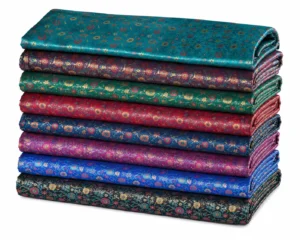
For occasions that demand greater visual impact, Banarasi brocade fabric can create a striking festive garment.
Brocade can incorporate elaborate woven motifs and metallic yarns, giving the textile a rich ceremonial appearance.
For men’s kurtas, it is important to choose the pattern carefully.
A very dense or oversized design may work better for a jacket than for a full kurta.
However, a refined brocade with controlled motif scale can produce an impressive festive outfit.
Brocade can be particularly appropriate for:
- major Diwali celebrations
- wedding functions
- engagement ceremonies
- groom wear
- festive receptions
- formal family occasions
For a more contemporary approach, pair a brocade kurta with simple trousers and minimal accessories.
Let the fabric remain the centre of attention.
5. Geometric Jacquards for Modern Men’s Kurtas
Geometric patterns are becoming increasingly important in contemporary men’s ethnic fashion.
They provide texture while maintaining a structured, modern appearance.
Popular geometric concepts include:
- diamonds
- squares
- stripes
- checks
- grids
- hexagons
- lattice formations