
The traditional boundaries between ethnic wear and contemporary fashion are becoming increasingly flexible. A kurta can be paired with a structured jacket. A bandhgala can incorporate modern geometry. A groom can choose an asymmetric Indo-Western silhouette instead of a conventional sherwani. Heritage textiles can be interpreted through minimalist tailoring, while traditional motifs can appear in completely contemporary colour palettes.
At the centre of this transformation is the Indo-Western outfit.
Indo-Western menswear combines elements of Indian textile and clothing traditions with contemporary silhouettes, styling and tailoring. It gives designers enormous creative freedom while allowing customers to remain connected to Indian fashion.
Among the textiles that can work particularly well for this category, Banarasi fabrics offer exceptional possibilities.
Banarasi jacquards can introduce woven geometry and texture. Brocades can become statement jackets. Katan silk can provide refined character. Self-jacquards can create minimalist luxury. Traditional florals can be reinterpreted through modern silhouettes, while checks and stripes can introduce a completely different visual language.
At Choubey Silk, Varanasi, our focus is on premium fabrics for men’s ethnic, wedding and occasion wear, including textiles suitable for Indo-Western garments, kurtas, sherwanis, Nehru jackets, bandhgalas, wedding jackets and groom wear.
Our collections include Banarasi jacquard, brocade, Katan silk, Moonga, Chiniya, raw silk, satin-based fabrics and other premium woven textiles for different design and garment requirements.
For fashion designers, boutiques, wedding retailers, grooms, wholesalers and garment manufacturers, Indo-Western fashion creates an opportunity to use Banarasi textiles in entirely new ways.
This guide explores the most important Indo-Western fashion trends using Banarasi fabrics and how heritage weaving can become part of modern men’s fashion.
What Is Indo-Western Men’s Fashion?
Indo-Western fashion combines elements associated with Indian clothing and textiles with contemporary or Western-influenced silhouettes, construction and styling.
For men, this can include:
- Asymmetric kurtas
- Structured jackets
- Long jackets
- Bandhgalas
- Layered outfits
- Contemporary sherwanis
- Nehru jackets
- Fusion wedding outfits
- Modern groom wear
The objective is not simply to place an Indian textile on a Western garment.
The most successful Indo-Western fashion creates a thoughtful relationship between textile, silhouette, colour and construction.
This is precisely where Banarasi fabrics become interesting.
Why Banarasi Fabrics Work for Indo-Western Fashion
Banarasi textiles contain a broad design vocabulary.
Traditional directions can include:
- Florals
- Butis
- Jaals
- Paisleys
- Botanical patterns
- Mughal-inspired motifs
- Zari detailing
Contemporary woven designs can include:
- Geometry
- Checks
- Stripes
- Self-patterns
- Abstract arrangements
- Tonal jacquards
- Modern metallic effects
This means the textile can move between heritage and contemporary fashion relatively naturally.
A traditional floral brocade can become a sharply tailored jacket.
A geometric jacquard can create a futuristic Indo-Western silhouette.
A self-jacquard can become a minimalist bandhgala.
The same weaving tradition can therefore serve very different design identities.
Banarasi Jacquard: A Foundation for Modern Indo-Western Wear
Banarasi jacquard is particularly relevant to contemporary men’s fashion because the woven design can range from subtle to dramatic.
For Indo-Western garments, jacquard can include:
- Geometric patterns
- Self-designs
- Small florals
- Checks
- Stripes
- Abstract motifs
- Zari details
This makes jacquard highly adaptable.
Designers can choose the fabric according to the garment rather than forcing the garment to fit one traditional textile aesthetic.
Trend 1: Geometric Banarasi Jacquard
One of the strongest directions in contemporary men’s Indo-Western fashion is geometry.
Geometric jacquards can include:
- Diamonds
- Grids
- Interlocking forms
- Linear arrangements
- Architectural shapes
- Abstract repeats
- Structured motifs
These patterns work particularly well with tailored silhouettes.
A geometric Banarasi jacquard can become:
- An asymmetric jacket
- A bandhgala
- A contemporary groom outfit
- A Nehru jacket
- A structured long jacket
Geometry creates a clear connection with modern menswear while the woven surface maintains textile depth.
Trend 2: Self-Jacquard and Minimal Luxury
Not every Indo-Western outfit needs a strong pattern.
Minimal luxury is becoming an important direction in men’s occasion wear.
Self-jacquard supports this aesthetic beautifully.
The pattern remains close to the base colour.
Instead of strong contrast, the textile reveals itself through texture and light.
This can work particularly well in: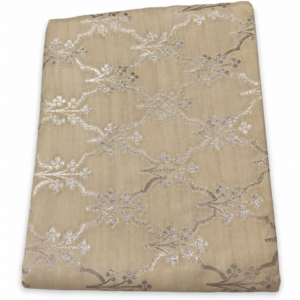
- Ivory
- Cream
- Champagne
- Beige
- Pastels
- Navy
- Wine
A self-jacquard bandhgala or Indo-Western jacket can feel sophisticated without appearing heavily decorated.
Trend 3: Banarasi Brocade Statement Jackets
Brocade can create a completely different Indo-Western aesthetic.
Rather than using rich fabric across the entire outfit, designers can concentrate it in one garment.
For example:
A brocade jacket can be paired with a plain kurta.
A patterned long jacket can be worn over a minimal inner layer.
A brocade Nehru jacket can become the focal point of an otherwise restrained outfit.
This approach allows the richness of Banarasi fabric to stand out without overwhelming the complete look.
Trend 4: Heritage Florals with Modern Silhouettes
Traditional floral textiles do not need to produce traditional garments.
This is one of the most important ideas in Indo-Western design.
A floral Banarasi fabric can become a contemporary asymmetric jacket.
A Mughal-inspired pattern can be used in a structured bandhgala.
A small floral jacquard can become a modern cropped Nehru jacket.
The textile provides heritage.
The silhouette provides modernity.
The contrast between the two creates the Indo-Western identity.
Trend 5: Smaller Motifs for Cleaner Men’s Fashion
Large motifs can create dramatic garments, but smaller patterns are often particularly useful for modern men’s tailoring.
Small motifs can provide:
- Better pattern continuity
- Greater cutting flexibility
- More restrained visual impact
- Easier application across panels
They can work especially well for:
- Bandhgalas
- Short jackets
- Layered outfits
- Contemporary kurtas
- Indo-Western sherwanis
For commercial menswear collections, smaller repeats can also offer greater flexibility across different garment sizes.
Trend 6: Checks with a Banarasi Character
Checks are already deeply familiar in men’s fashion.
Reinterpreting them through jacquard creates an interesting fusion.
A Banarasi-inspired check can include:
- Tonal grids
- Metallic lines
- Multi-scale checks
- Textured intersections
- Geometric combinations
These designs can work particularly well for jackets and bandhgalas.
They feel recognisably connected to men’s tailoring while offering more woven depth than a conventional check.
Trend 7: Striped Indo-Western Fabrics
Stripes are another classic menswear pattern that can be reinterpreted through woven textiles.
Vertical jacquard lines can visually lengthen the garment.
Tonal stripes can create subtle texture.
Metallic stripes can provide wedding character.
Complex woven stripes can combine geometry and traditional textile elements.
Striped Banarasi-inspired fabrics can be considered for:
- Long jackets
- Kurtas
- Bandhgalas
- Nehru jackets
- Layered Indo-Western outfits
Trend 8: Antique Gold Instead of Excessively Bright Metallics
Gold remains important in Indian wedding fashion, but contemporary styling often benefits from softer metallic tones.
Antique gold can create richness without becoming excessively bright.
It works particularly well with:
- Ivory
- Champagne
- Beige
- Pista
- Baby pink
- Navy
- Wine
Antique gold can be used in geometric patterns, florals, small butis and abstract jacquards.
For Indo-Western fashion, this creates a sophisticated balance between ceremonial richness and modern restraint.
Trend 9: Copper Accents in Men’s Wedding Fabrics
Copper provides another interesting direction for modern men’s fashion.
Its warmer tone can feel contemporary and distinctive.
Copper can appear in:
- Geometric outlines
- Small motifs
- Checks
- Abstract patterns
- Floral details
It can also be combined with antique gold.
For designers trying to move beyond conventional bright gold, copper provides another metallic vocabulary.
Trend 10: Controlled Meena Detailing
Meena can introduce carefully selected colour accents within woven motifs.
For men’s Indo-Western fabrics, restraint is important.
Small amounts of baby pink, pista, blue, copper or another complementary shade can add depth without making the textile overly colourful.
This can be particularly effective for groom wear because the fabric can coordinate with the wider wedding palette.
Trend 11: Ivory Indo-Western Outfits
Ivory continues to be one of the most versatile colours in men’s wedding fashion.
But an ivory Indo-Western outfit does not need to look conventional.
The colour can be combined with:
- Geometric jacquard
- Self-patterns
- Antique gold
- Copper
- Tonal checks
- Subtle florals
This makes ivory suitable for both minimalist and statement styling.
Trend 12: Champagne and Beige Menswear
Champagne and beige offer a warmer contemporary alternative to white and ivory.
These colours work particularly well with woven texture.
A champagne geometric jacquard can create a sophisticated engagement outfit.
A beige self-jacquard can become a minimalist bandh