Indian men’s fashion continues to evolve.
Silhouettes are becoming cleaner. Colours are becoming more experimental. Geometric patterns are appearing alongside traditional florals. Indo-Western styling has expanded the possibilities of ethnic dressing, while Nehru jackets, bandhgalas and contemporary wedding layers are giving men more ways to express personal style.
Yet through all these changes, one fabric family continues to hold a special place in premium Indian menswear:Silk.
From elegant festive kurtas to sophisticated wedding outfits, silk has a visual character that is difficult to replace.
It interacts beautifully with light.
It can carry woven patterns with remarkable depth.
It can appear luxurious without requiring excessive embellishment.
And depending on the particular silk fabric and construction, it can move between understated elegance and ceremonial richness.
This is why silk kurtas for men continue to remain relevant in 2026.
The modern silk kurta is also no longer limited to one traditional interpretation.
Today, men can explore: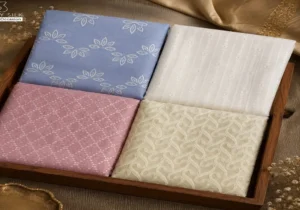
- Plain silk kurtas
- Katan silk kurtas
- Banarasi jacquard kurtas
- Self-jacquard kurtas
- Geometric silk kurtas
- Floral woven kurtas
- Small-buti kurtas
- Zari-detailed kurtas
- Pastel silk kurtas
- Contemporary wedding kurtas
At Choubey Silk, Varanasi, our focus is on premium fabrics for men’s ethnic, wedding and occasion wear. Our broader collections include Banarasi jacquard, brocade, Katan silk, Moonga, Chiniya, raw silk, satin-based fabrics and other premium woven textiles that can be explored for kurtas, sherwanis, Indo-Western outfits, Nehru jackets, bandhgalas and wedding jackets.
For men planning their festive wardrobes, grooms selecting fabrics for wedding functions, designers creating menswear collections, boutiques sourcing premium textiles and garment manufacturers developing ethnic-wear ranges, silk continues to offer enormous possibilities.
Here is why silk remains one of the defining materials of Indian men’s ethnic wear.
Why Silk Kurtas Have Enduring Appeal
Fashion trends change quickly.
Premium fabrics tend to have a longer life.
Silk has remained important because its appeal is not dependent on one particular pattern, colour or silhouette.
The same broad textile family can support very different aesthetics.
A plain silk kurta can appear refined and minimal.
A woven Banarasi silk fabric can create ceremonial richness.
A self-jacquard can provide subtle texture.
A geometric jacquard can feel contemporary.
A fabric with carefully controlled zari can become ideal for wedding wear.
This versatility allows silk to evolve with men’s fashion instead of becoming restricted to one period or style.
What Makes Silk Special for Men’s Kurtas?
A kurta is a relatively simple garment structurally.
That simplicity makes the fabric highly visible.
There may be fewer construction details than in a heavily tailored jacket or sherwani, which means the surface of the textile becomes an important part of the design.
Silk can provide:
- Natural-looking lustre
- Surface depth
- Rich colour
- Elegant drape
- Woven texture
- Premium visual character
The exact qualities depend on the specific fabric, weave and construction.
That distinction is important.
Not every silk textile behaves in exactly the same way, and fabric should always be selected according to the intended garment.
Silk and the Heritage of Indian Menswear
Silk has a long relationship with Indian ceremonial and occasion dressing.
For modern menswear, the value of this heritage is not that designers must reproduce historical clothing exactly.
The opportunity is to reinterpret traditional textile character.
A heritage-inspired motif can be reduced in scale.
A traditional floral can be woven in a contemporary colour.
Gold can become antique gold.
Bright colour contrast can become tonal.
Classic butis can be incorporated into a minimalist kurta.
Geometry can bring a completely different visual language to woven silk.
This is how traditional textile vocabulary remains relevant to contemporary fashion.
Varanasi and the Language of Banarasi Textiles
Varanasi—also known as Banaras and Kashi—has a deep association with woven textile traditions.
The visual vocabulary associated with Banarasi fabrics includes a wide variety of designs, such as:
- Florals
- Butis
- Jaals
- Paisleys
- Botanical motifs
- Geometric patterns
- Zari effects
- Contemporary woven designs
For men’s kurtas, these design directions can be interpreted with greater restraint.
The objective is not necessarily to cover every kurta in highly elaborate pattern.
Sometimes the most effective menswear fabric is one where the richness becomes visible gradually.
Katan Silk for Men’s Kurtas
Katan silk has particular relevance within premium Banarasi textile traditions.
For men’s ethnic wear, the attraction of Katan silk lies in its refined silk character and its ability, depending on the particular construction, to support premium garment applications.
Katan silk can be explored for: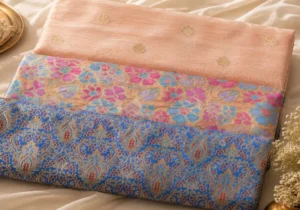
- Wedding kurtas
- Festive kurtas
- Groom kurtas
- Designer kurtas
- Premium occasion wear
When choosing Katan silk for a kurta, evaluate the actual fabric rather than relying only on the fibre or fabric name.
Consider:
- Weight
- Drape
- Surface
- Weave
- Colour
- Pattern
- Intended season
- Garment construction
The best fabric is the one that works with the intended kurta.
Banarasi Jacquard for Men’s Silk Kurtas
One of the most versatile directions for modern men’s kurtas is Banarasi jacquard.
Jacquard allows design to become part of the woven structure of the textile.
This can create visual depth without relying solely on surface embellishment.
For men’s kurtas, jacquard directions can include:
- Self-patterns
- Geometry
- Small florals
- Butis
- Checks
- Stripes
- Tonal designs
- Metallic details
This versatility is particularly valuable because men’s customers do not all want the same level of decoration.
Self-Jacquard Silk Kurtas: The Rise of Understated Luxury
Not every luxury kurta needs a highly visible pattern.
Self-jacquard is ideal for men who prefer subtle sophistication.
The woven pattern stays relatively close to the base colour.
From a distance, the fabric can appear minimal.
As the light changes or the wearer moves, the pattern becomes more visible.
This creates depth without excessive contrast.
Self-jacquard works particularly well in colours such as:
- Ivory
- Cream
- Champagne
- Beige
- Powder blue
- Pista
- Baby pink
- Navy
- Wine
For 2026 menswear, this type of understated textile can work especially well with clean kurta silhouettes.
Geometric Silk Kurtas for Modern Men
Geometry has become increasingly important in contemporary men’s ethnic fashion.
Traditional florals remain relevant, but geometric design can make a woven silk kurta feel more architectural and modern.
Possible patterns include:
- Diamonds
- Grids
- Linear motifs
- Interlocking forms
- Abstract repeats
- Small geometric butis
These designs can work particularly well for men who appreciate Indian textiles but prefer a cleaner visual language.
Why Geometry Works So Well in Men’s Fashion
Geometry already has a strong relationship with menswear.
Think about:
- Checks
- Stripes
- Suiting patterns
- Grids
- Repeating lines
Translating these ideas into Banarasi jacquard creates an interesting bridge between Indian textile heritage and contemporary menswear.
An ivory-and-antique-gold geometric kurta can look wedding-ready.
A tonal navy geometric kurta can work for an evening event.
A champagne geometric silk fabric can create a sophisticated engagement outfit.
Floral Silk Kurtas for Men
Florals remain an important part of Banarasi design.
The modern question is not whether men can wear floral textiles.
It is how the floral is designed.
Men’s kurta fabrics can explore:
- Small floral butis
- Stylised botanicals
- Tonal florals
- Mughal-inspired florals
- Antique-gold floral patterns
- Floral geometry
Motif scale and colour can dramatically change the final appearance.
A small tonal floral can feel subtle.
A larger metallic floral can become more ceremonial.
Small-Buti Silk Kurtas
Small butis are among the most versatile directions for men’s kurtas.
They create a consistent visual rhythm across the fabric without dominating the garment.
They can work for:
- Wedding guests
- Engagements
- Festive occasions
- Family celebrations
- Groom pre-wedding events
Butis can be:
- Floral
- Geometric
- Tonal
- Metallic
- Meena-accented
The smaller scale also makes them relatively adaptable across different garment sizes.
Zari and Men’s Silk Kurtas
Zari can add festive character to silk fabrics, but menswear does not always require maximum metallic coverage.
Different levels can create very different results.
Subtle Zari
Suitable for understated festive kurtas.
Moderate Zari
Useful for wedding and occasion wear.
Richer Zari
Can work for groom wear or more ceremonial garments.
The amount should be selected according to the event and the wearer’s personal style.
Antique Gold: A Refined Direction for Silk Kurtas
Gold has long been associated with Indian occasion wear.
For contemporary menswear, antique-gold effects can provide a more restrained alternative to extremely bright metallics.
Antique gold works particularly well with:
- Ivory
- Cream
- Champagne
- Beige
- Pista
- Baby pink
- Navy
- Wine
It can appear in:
- Butis
- Geometry
- Florals
- Stripes
- Borders
- Abstract patterns
This makes it highly versatile.
Copper Accents in Contemporary Silk Fabrics
Copper offers another interesting direction.
Its warmer character can work beautifully with both neutral and coloured bases.
Consider combinations such as:
- Champagne and copper
- Beige and copper
- Pista and copper
- Baby pink and copper
- Navy and copper
Copper can be particularly effective within geometric jacquard and contemporary woven patterns.
Meena Details in Men’s Silk Kurtas
Meena can introduce carefully controlled colour into woven patterns.
For men’s fabrics, restraint can create sophisticated results.
Tiny accents of:
- Baby pink
- Pista
- Blue
- Copper
- Complementary colours
can bring additional depth to a neutral base.
An ivory silk fabric with antique-gold geometry and small meena accents, for example, can feel distinctly festive without becoming overly colourful.
Ivory Silk Kurtas for Men
Ivory is one of the most versatile colours in Indian menswear.
But an ivory kurta does not need to be plain.
Texture can provide differentiation.
Consider:
- Ivory self-jacquard
- Ivory with antique-gold butis
- Ivory geometric jacquard
- Ivory tonal floral
- Ivory with controlled meena
The neutral colour allows the weave to become more visible.
Cream Silk Kurtas
Cream offers a slightly warmer alternative.
It works particularly well with:
- Gold
- Antique gold
- Copper
- Tonal patterns
- Small florals
Cream silk kurtas can work for daytime weddings, festive occasions and traditional ceremonies.
Champagne Silk Kurtas
Champagne has become particularly useful in contemporary men’s wedding fashion.
It feels neutral but carries more warmth than ivory.
Champagne can be paired with:
- Antique gold
- Copper
- Beige
- Tonal geometry
- Pastel accents
It is particularly suitable for engagements and sophisticated daytime events.
Pastel Silk Kurtas for Men
Pastels have expanded the colour vocabulary of men’s wedding wear.
Popular directions include: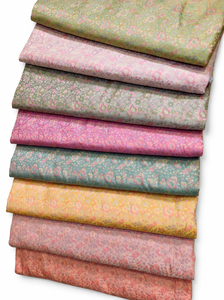
- Baby pink
- Pista
- Sage
- Powder blue
- Lavender
- Peach
Silk and woven jacquard can make pastels more interesting because the surface interacts with light.
A pastel colour combined with woven texture often looks more sophisticated than a completely flat surface.
Dark Silk Kurtas for Evening Wear
Silk is not limited to light wedding colours.
Evening functions can support darker shades such as:
- Navy
- Wine
- Maroon
- Deep green
- Dark jewel tones
These colours can work particularly well with:
- Tonal jacquard
- Antique-gold butis
- Metallic geometry
- Subtle florals
Artificial lighting can emphasise the woven pattern.
Silk Kurtas for Engagements
An engagement generally calls for polished festive dressing without necessarily reaching the formality of the wedding ceremony.
Good fabric directions include:
- Champagne self-jacquard
- Ivory geometry
- Beige woven silk
- Pastel jacquard
- Small metallic butis
Pair the kurta with clean trousers or add a Nehru jacket if greater formality is required.
Silk Kurtas for Mehendi
Mehendi allows greater experimentation with colour.
Consider:
- Pista
- Sage
- Pink
- Peach
- Powder blue
Smaller woven motifs can create festive energy while keeping the garment relatively easy to style.
Silk Kurtas for Sangeet
The sangeet is ideal for stronger evening styling.
Consider:
- Navy
- Wine
- Dark jacquard
- Metallic geometry
- Richer woven patterns
A silk kurta can be paired with a statement jacket if the event is particularly formal.
Silk Kurtas for the Wedding Ceremony
The main wedding ceremony is where premium silk textiles can truly come into their own.
For a guest, consider:
- Ivory jacquard
- Katan silk
- Small-buti fabric
- Subtle zari
- Premium Banarasi woven fabric
For the groom or close family, richer textile directions may be appropriate depending on the dress code.
Silk Kurtas for Reception Events
A reception often allows a more contemporary approach.
Instead of a traditional light-coloured kurta, consider:
- Navy silk
- Wine jacquard
- Dark tonal fabric
- Geometric woven silk
The kurta can also be layered with a bandhgala or jacket.
Silk Kurtas for the Groom
A groom’s wardrobe usually includes several events.
Silk allows each function to have a distinct identity.
Engagement
Champagne geometric silk kurta.
Mehendi
Pastel woven kurta.
Sangeet
Dark jacquard kurta.
Wedding Morning
Ivory or cream premium silk.
Additional Wedding Function
Katan silk or Banarasi woven fabric.
This creates variety while maintaining a premium textile story throughout the wedding.
Silk Kurtas for Wedding Guests
Wedding guests can use silk to create festive clothing without matching the groom’s ceremonial richness.
Good directions include:
- Self-jacquard
- Small butis
- Pastel silk
- Subtle geometry
- Controlled zari
A guest outfit should feel special while remaining appropriate to the event.
Silk Kurtas for Festivals
Silk kurtas are not limited to weddings.
They can also work beautifully for:
- Diwali
- Eid celebrations
- Family ceremonies
- Festive dinners
- Religious functions
- Cultural celebrations
For festivals, the textile can often be simpler than a wedding kurta.
Self-jacquard and small butis are particularly useful.
Silk Kurtas for Destination Weddings
Destination weddings place greater emphasis on versatility.
Daytime events may favour:
- Ivory
- Champagne
- Pastels
- Smaller motifs
- Cleaner styling
Evening events can transition into:
- Navy
- Wine
- Dark jacquards
- Metallic details
Climate should always be considered when selecting fabric and layering.
Plain Silk vs Jacquard Silk for Kurtas
Both can be excellent.
They simply serve different design objectives.
Plain Silk
Allows colour, drape and surface character to lead.
It also provides greater freedom for accessories or jackets.
Jacquard Silk
Adds